cmka1h39t00041opjelu825lh • 1K
The Salted Anchor Tavern
Description
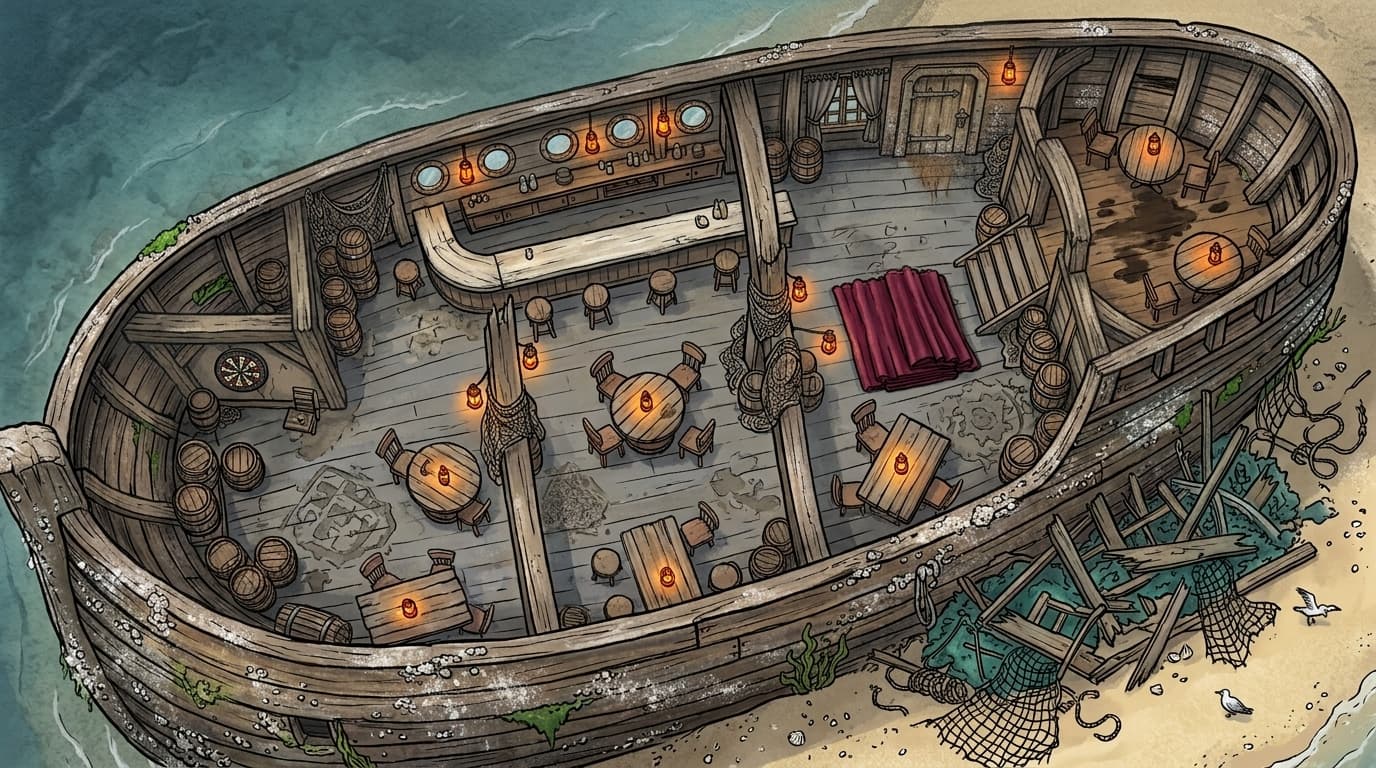
The Salted Anchor doesn't look like a building that happens to use ship parts — it looks like a ship that happens to have a door cut into its side. The whole structure is the hull of a large old trading vessel, hauled up onto the Windshear shoreline decades ago and converted wholesale rather than picked apart for materials. Step through the door — it sticks a little before it gives — and the effect is immediate: the ceiling curves above the way a hull curves, following the ship's original shape rather than running flat the way a normal room's would. Heavy wooden support pillars run down both sides of the room at regular intervals, thick and load-bearing, standing where the ship's ribs and internal bulkheads once braced against open water. The floor holds a faint, permanent tilt, just enough to notice, like the whole building never quite forgot it used to ride waves instead of sand. Along one long wall runs the bar — the most obviously finished part of the room, its wooden surface worn pale in a long path where years of elbows have rested. This is the oldest surviving section of the original hull, and it shows: a curved plank-seam is still visible in the wood behind it, unmistakably a piece of ship's hull rather than a milled beam. A scattering of portholes, still intact, run along this same wall — small, round, glass-paned, doing actual duty as the room's windows rather than being purely decorative. The rest of the room is a comfortable clutter. Tables are everywhere and none of them match — some are simple rectangular plank tables built from timber offcuts, others are round, clearly repurposed from old barrel tops, all of them a little rickety, a little scarred, entirely sturdy despite how they look. Wedged between and around the tables: stacked barrels (some empty, some not, nobody's entirely sure which), and coils of old fishing net draped over pillars and hung in corners, salt-stiffened, more load-bearing atmosphere at this point than actual decoration. A dartboard, missing half its numbers, hangs slightly crooked on a wall near the stairs leading up to the guest rooms. There are glowing amber lanterns hanging from pillars and on tables. Toward the back of the room, partly shielded from the main floor by the layout of the old hull's internal framing, a smaller, quieter nook holds a couple of tables set apart from the noise — the natural spot for a private conversation, made possible less by design and more by the accident of where the original ship's internal walls happened to still be standing, with dark oil stains soaking into the wooden floor.
Sign in to add this map to your collection.


